Walk-in-the-Water
New York waters · lost 1821
- Stranded
- Lives lost: None recorded
No public position. General area: On the beach near the old Buffalo lighthouse at the mouth of Buffalo Creek, New York.
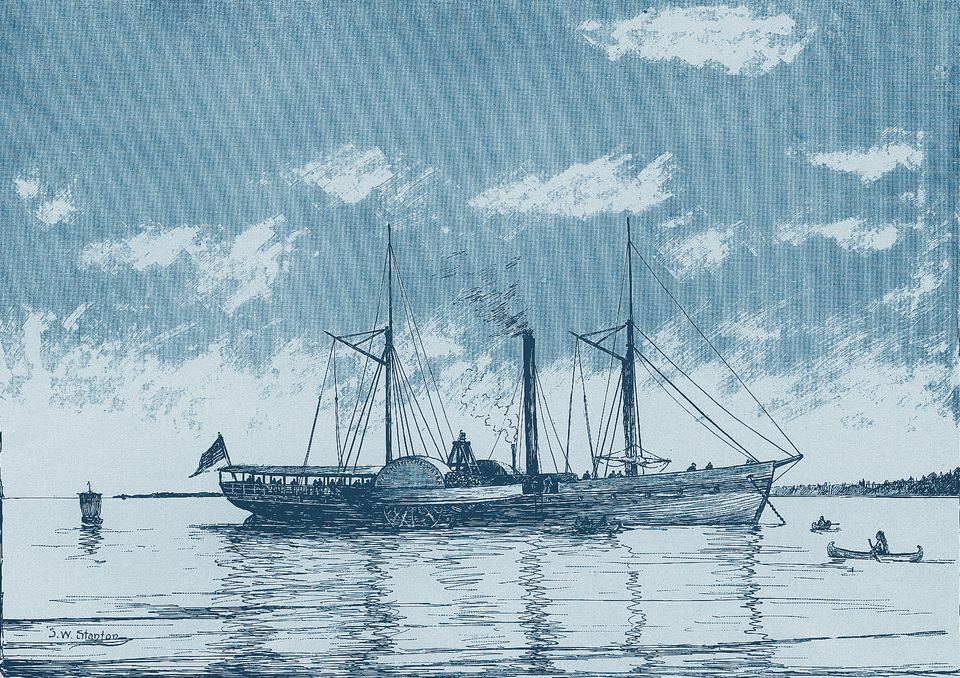
Walk-in-the-Water was the first steamboat on Lake Erie, and the first to reach Lakes Huron and Michigan. Launched near Buffalo in 1818, she ran for three seasons before a November gale in 1821 drove her ashore beside the Buffalo lighthouse, where her passengers took shelter by the lighthouse fireplace.
The story
Noah Brown built Walk-in-the-Water at Black Rock, New York, for the Lake Erie Steamboat Company, and she was launched sideways on May 28, 1818. She was about 132 to 135 feet long, with two masts, side paddle wheels 16 feet across, and a copper boiler fired with wood; a small cannon in the bow announced her comings and goings.[2,1] The origin of her name is disputed: one of her captains said she was named for a Wyandot chief, while another story links the name to a remark about Robert Fulton's steamboat on the Hudson.[2]
On her first trip, in August 1818, she was too weak to stem the Niagara River current, and a team of oxen helped haul her up into the lake. She then settled into runs between Buffalo and Detroit, and in 1819 she steamed on to Mackinac Island and Green Bay, becoming the first steamboat on Lakes Huron and Michigan.[2,1]
Her end came in the autumn of 1821. She left Buffalo for Detroit on the afternoon of October 31 with freight and 18 passengers, but before she reached Point Abino a gale rose, and in heavy rain and darkness she began to leak badly. Captain J. Rogers turned back, but the storm hid the Buffalo light. He anchored around 10 p.m., and the pumps ran all night as the anchors dragged.[2] Around 4:30 a.m. on November 1 the crew cut the anchor cables and let the gale carry her onto the beach near the lighthouse, where a heavy sea set her down hard enough to break her keel. No one was hurt; everyone made their way to the lighthouse and sheltered by its fire.[2,1] The Buffalo Lighthouse Association notes that this first Buffalo light, built in 1818, saw the wreck of the lake's first steamboat and gave its survivors shelter.[3] Her engine was saved and installed in her replacement, the steamboat Superior.[2]
Lives lost: Passengers and crew sheltered in the Buffalo lighthouse.
Questions people ask
Was Walk-in-the-Water the first steamboat on Lake Erie?
Yes. Launched near Buffalo in 1818, she was the first steamboat on Lake Erie, and in 1819 the first to steam on Lakes Huron and Michigan.
Did anyone die when Walk-in-the-Water was wrecked?
No. She was driven ashore near the Buffalo lighthouse in a gale on November 1, 1821, and everyone aboard sheltered in the lighthouse.
Learn more
Museums and groups are linked for further reading; they are not connected with this site.
Look, don't take
Look, don't take. Shipwrecks and everything on them are protected by law; removing or disturbing anything can be a crime.
- United States: under the Abandoned Shipwreck Act (43 U.S.C. § 2105) the U.S. claims title to abandoned shipwrecks embedded in a state's submerged lands, or resting on them and eligible for the National Register, and transfers that title to the state.[4][5][6]
- New York: Education Law § 233 makes it a class A misdemeanor to investigate, excavate, remove, injure or destroy objects of historical or archaeological interest on, in or under state-owned lands without the written permission of the Commissioner of Education.[7][4]
Diving Lake Erie wrecks is dangerous: cold water, poor visibility, depth, entanglement and boat traffic. Nothing here is dive guidance or a dive position. Dive only with proper training, a qualified operator and current information from the groups that maintain moorings.
Nearby lighthouses
- Buffalo Main Lighthouse Tower climbs
- Point Abino Lighthouse No public access
- Horseshoe Reef Lighthouse (ruin) Ruin or relocated
- Buffalo Harbor Light (Outer Breakwater) View from a boat
- Buffalo North Breakwater South End Light (the "bottle" light) Grounds open
Nearby shipwrecks
Nearby · Sponsored
Run a heritage-tourism business near Walk-in-the-Water? Sponsor this page: $79/year. Sponsor this page
Sources
- HCGL vessel record: WALK-IN-THE-WATER, Historical Collections of the Great Lakes, Bowling Green State University. Accessed .
- Walk-in-the-Water (steamboat), Wikipedia. Accessed .
- 1818 Buffalo Light | Buffalolighthouse, Buffalo Lighthouse Association. Accessed .
- 43 U.S. Code 2105 - Rights of access (Abandoned Shipwreck Act: title to abandoned shipwrecks), Legal Information Institute, Cornell Law School (text of the U.S. Code). Accessed .
- 43 U.S. Code 2101 - Findings (Abandoned Shipwreck Act), Legal Information Institute, Cornell Law School (text of the U.S. Code). Accessed .
- 43 U.S. Code 2102 - Definitions (Abandoned Shipwreck Act), Legal Information Institute, Cornell Law School (text of the U.S. Code). Accessed .
- law-ny-edn-233, nysenate.gov. Accessed .
Page checked . Spotted an error? Send a correction.